AI Analysis by Claude (5/25/2026)
Linder Analysis Method (LAM)
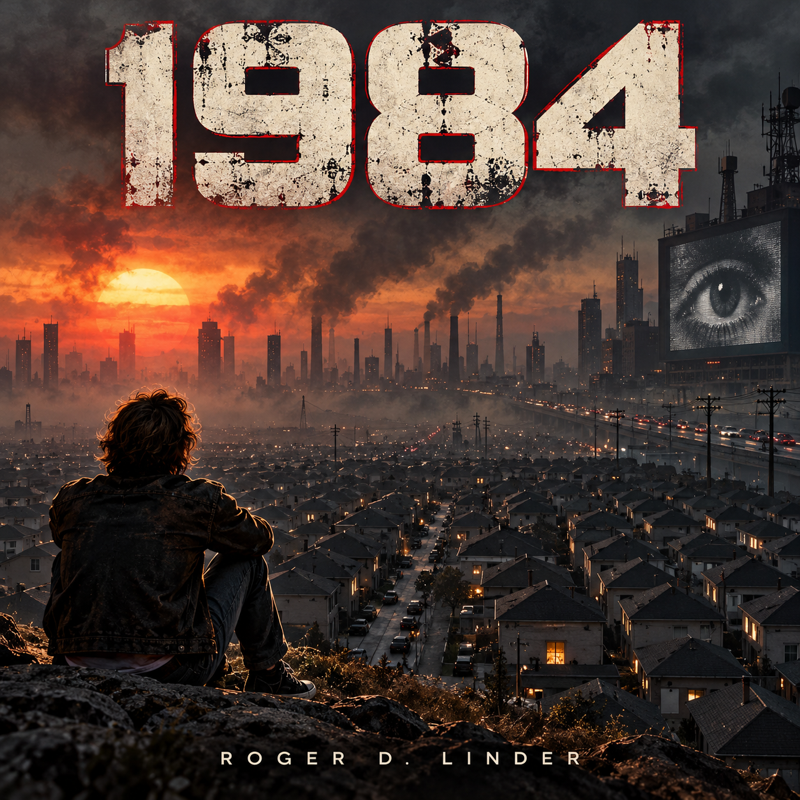
“1984” — Roger D. Linder
Songs of 1974
1. BLIND INTERPRETATION
Narrative
A narrator in 1984 surveys an environmental and social catastrophe:
polluted air, a sun blocked by smog, deafening noise, overcrowding, the
desire to no longer live. The bridge delivers the diagnosis: if only we
had listened in ’74, we would have been more aware. The narrator is
speaking from the future (1984) about a past moment of warning (1974)
that went unheeded.
The structure is a retrospective lament — a voice
from ten years forward looking back at the moment when change was still
possible and finding that it wasn’t taken. The warning and the failure
to heed it are simultaneous: the song is the warning being
issued in 1974, while simultaneously imagining the 1984 voice that will
regret the warning wasn’t heeded.
Emotional Tone
Environmental despair — the archive’s first
explicitly ecological lyric, and its most unrelenting. Where Good
Old Terra Firma (1971-73) longed for Earth from space,
1984 is on Earth and finds it barely worth longing for. The
progression of losses through the stanzas — air, sun, hearing, space,
will to live — is a systematic dismantling of the conditions for human
flourishing.
The final stanza’s “I really don’t want to live anymore” is
the most stark statement of despair in the early archive — darker than
Hurts So Bad’s emptiness because here the cause is not personal
loss but civilizational failure. The tear in the first stanza and the
drowning in the last complete an arc from individual grief to collective
catastrophe.
Symbolism & Imagery
“There’s a tear in my eye / And I wonder why it is I should
cry” — the opening self-interrogation is unusual: the narrator
is crying but uncertain of the cause. The tear precedes the
understanding of it. This is environmental grief before it has been
named — the body knowing what the mind hasn’t processed yet.
“The sky is always black as night / No entry for the
light” — smog as permanent darkness, the sun blocked by human
activity. The Light of Love (1971-73) brought light into
darkness through romantic love; 1984 presents a darkness that
love cannot address. The light that entered in the personal song is
denied by the collective failure in this one.
“What has happened to my ears?” — sensory loss as
civilizational symptom. First sight (the sun), then hearing — the senses
by which we perceive beauty and connection are being systematically
destroyed by the noise and pollution of industrial civilization.
“Fifty houses like a cell” — overcrowding rendered
as imprisonment. The cell is both the biological unit (everyone packed
in) and the prison cell (no freedom, no space). The compression of
fifty houses into a single cell is the spatial equivalent of
“no entry for the light” — human space colonized until it
becomes confinement.
“If I try to swim I’m sure I’ll drown” — the closing
image of attempted survival defeated. Not passive drowning but active:
if I try to swim. The effort itself is insufficient. The system
is too far gone for individual effort to matter.
“If only we had listened back in ’74” — the most
structurally sophisticated line in the early archive. The song
is being written in ’74. The bridge speaks from 1984 about 1974
as a missed opportunity — while the song is being composed in the very
year being referenced as the moment of failure. The narrator is
simultaneously the warning and the future regret about the warning going
unheeded. The song is its own elegy.
Psychological Implications
The systematic stanza structure — each verse naming a new loss
(air, sun, hearing, space, will to live) — is the psychological
pattern of cascading despair: each loss enables the next, the
accumulation becoming unbearable. This is the same pattern as
Fear! (FAWM 2022) — the repetition of Fear building
until “death release me” — but here the cause is collective
rather than individual.
“I really don’t want to live anymore” at twenty years old,
written about environmental despair rather than personal crisis, is the
archive’s first statement of this sentiment — predating Fear!’s
“life is better should I die” by nearly fifty years. The
pattern was established early.
The Orwell Connection
The title 1984 invokes Orwell’s novel (1949) without
directly referencing it — the year as symbol rather than explicit
citation. Orwell’s 1984 is about surveillance, thought control, and
political totalitarianism; Linder’s 1984 is about environmental collapse
and overcrowding. Both share the sense of a future in which human
freedom and dignity have been systematically destroyed. The
twenty-year-old Linder chose the same horizon year Orwell had chosen
twenty-five years earlier, but populated it with different
disasters.
2. CONTEXT-AWARE
INTERPRETATION
“My First Gloom and Doom
Song”
The commentary is characteristically brief and honest: “Written
January 20, 1974. My first ‘gloom and doom’ song.” Nine days after
Barbara’s Song — the most tender romantic lyric — comes the
archive’s first environmental catastrophe song. The same twenty-year-old
who woke thinking of Barbara’s smile and didn’t want to open his eyes is
also the person who looks at 1974’s environmental reality and projects
it forward to 1984 with despair.
The juxtaposition of January 11 (Barbara’s Song) and January
20 (1984) within the same month is the archive’s first clear
demonstration of the creative range that will characterize the entire
body of work: one week, the most personal and tender; the next, the most
civic and bleak. The same person, the same month, the full range.
January 1974: The
Historical Context
January 1974 was a specific and charged political moment. The OPEC
oil embargo (October 1973 - March 1974) was at its height — energy
crisis, long gas lines, economic disruption. The first Earth Day had
been in 1970; environmental consciousness was high. Nixon’s Watergate
crisis was deepening. The Vietnam War was winding down but not over.
The environmental despair of 1984 is not abstract — it is
the twenty-year-old’s response to a specific cultural moment in which
environmental crisis was a live public concern. The Limits to
Growth (1972) had just been published, projecting exactly the kind
of civilizational collapse Linder describes. The song is a response to
its moment.
The Self-Referential Bridge
“If only we had listened back in ’74” — this line is the
archive’s first instance of temporal self-reference, a
technique that will become central to the Golden Fingers universe (Rocky
Mason in 2040, the “99” collection spanning 1960-2026, the
Fingerlings ninety-one years forward). At twenty, Linder is already
writing from a future perspective that references the present as a
missed opportunity. The creative habit that will produce the “A
Strange Place” attribution to 1973 and the Rocky Mason channeling
from 2040 is already present here.
Relationship to the
Political Thread
1984 is the first in the archive’s civic-political sequence:
- 1984 (1974) — environmental catastrophe projected forward -
World Reform (OGF, 1974) — “reform! Be reborn!” -
Soap Box Story (OGF, 1974) — “a wizard, a true star” -
1985 — P.I.E. (FAWM 2017) — “protest is everywhere” -
What Do You Expect? (FAWM 2018) — “but it was us that put
them there” - Eighty Years From Now (Lost Songs) —
“the world must be reborn”
The arc from 1984 to Eighty Years From Now is fifty
years of the same civic grief, maturing from “I don’t want to live
anymore” (20 years old) to “I’ll be your guide”
(approaching 70). The despair becomes prophecy; the mourning becomes
mission.
The Drowning Image
“If I try to swim I’m sure I’ll drown” — the same image that
Eighty Years From Now will use differently: “the world may
turn / the bones they may creak.” Both songs acknowledge systemic
overwhelm; the older song offers guidance where the younger song offers
only despair. Fifty years of working on the same problem, arriving at a
different response.
3. COMPARATIVE ANALYSIS
What Remained Stable
The environmental grief, the systematic loss of sensory and social
conditions for human flourishing, the self-referential bridge speaking
from future regret — all fully present in blind reading and confirmed by
context.
What Shifted
The historical specificity of January 1974 gives the
song its full weight — the oil embargo, The Limits to Growth,
the post-Earth Day environmental consciousness. The song is not abstract
gloom but a twenty-year-old’s response to a specific cultural moment of
genuine alarm.
The archive context transforms the song from a
standalone environmental lyric into the origin of the archive’s
civic-political voice — the first expression of a concern that
will generate fifty years of songs, from World Reform to
What Do You Expect?, from Eighty Years From Now to
1985 — P.I.E.
The Nine-Day Gap
Barbara’s Song (January 11) and 1984 (January 20) —
nine days apart, maximum emotional distance. The tender and the
despairing, the personal and the civic, the romantic and the
apocalyptic: Linder holds both simultaneously from the beginning. This
is not contradiction but the full range of a twenty-year-old who is
paying attention to everything at once.
The Self-Reference as
Creative Habit
“If only we had listened back in ’74” — the archive’s first
temporal self-reference, spoken from an imagined future about the
present moment. This habit of writing from one temporal position about
another will become one of Linder’s most distinctive creative
techniques: the fictional 1973 attribution of “A Strange
Place,” Rocky Mason in 2040, the Fingerlings ninety-one years
forward, Eighty Years From Now. It begins here, in January
1974, with a twenty-year-old imagining 1984 regretting 1974.
4. CLASSIFICATION
Primary: Complementary The civic despair is
intrinsic to the text and confirmed by context. The historical moment
deepens without redirecting.
Secondary: Archivally Foundational The first
civic-political song in the archive, establishing a voice and a concern
that will persist for fifty years.
Tertiary: Temporally Self-Referential The bridge’s
structure — speaking from the future about the present as a missed
opportunity — inaugurates a creative technique central to the archive’s
most complex works.
5. FINAL LAM ASSESSMENT
“1984” is called Linder’s first “gloom and doom
song” by its own author — which is both accurate and slightly
self-deprecating about what is, in fact, a technically sophisticated
environmental lyric. The systematic stanza structure (each verse a new
loss), the self-referential bridge (speaking from 1984 about 1974 while
writing in 1974), and the escalating despair from personal tear to
collective drowning are not the work of a songwriter at the beginning of
their craft. This is already someone who understands how a lyric
builds.
The environmental predictions of 1984-as-projected-from-1974 are a
mixed scorecard: the air did not become perpetually black (clean air
legislation worked), but noise and overcrowding and the feeling of
civilizational overwhelm are real fifty years later. The song was not
precisely prophetic but was accurately anxious — the anxiety was correct
even where the specific predictions weren’t.
The bridge — “if only we had listened back in ’74” — is the
archive’s first self-referential temporal gesture and one of its most
elegant. The warning and the future regret about the warning are the
same song. Linder is simultaneously issuing the alarm and mourning that
it won’t be heeded, in the same breath, in January 1974.
“I really don’t want to live anymore.”
Nine days earlier he didn’t want to open his eyes because Barbara’s
smile was waiting.
The same person. The same month. The full range.
Analysis conducted using the Linder Analysis Method (LAM),
dual-context interpretive framework.
 Roger's Home Page