Composer: Roger D. Linder
Date Written: Mid-1960s
The Popsicle man is here
Hurrah, hurrah, let’s cheer
The Popsicle man is here
Yeah
Let me fetch the song before analyzing it.
The archive’s earliest composition. The commentary establishes everything: “Words added to the Popsicle truck jingle that came through our neighborhood.”
This predates Do I Bring You Down? (1971) by approximately five to seven years. It predates the rock opera by nearly a decade. It predates everything.
The Popsicle man arrives. There is jubilation. He is here. The lyric is four lines and a yeah.
Pure, unmediated childhood joy — the register that the entire subsequent archive has been, in various ways, trying to recover. The tear in the eye of Do I Bring You Down? (1971), the somewhat-crazy love of Sunshine In The Morning (1974), the comfortable chair of This Chair (2026) — all of these are adults trying to feel what this song feels in four words: hurrah, hurrah, let’s cheer.
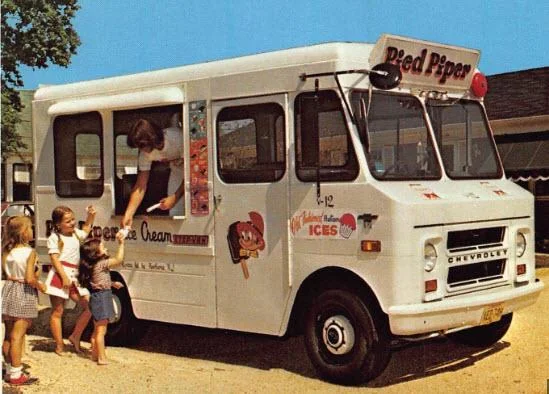
The Popsicle Man — the ice cream truck as the neighborhood’s herald of summer pleasure. His arrival is an event; his jingle is a summons; the words added to the jingle are the neighborhood child’s contribution to the ritual.
“Hurrah, hurrah, let’s cheer” — three exclamations, no ambivalence. The archive will spend the next sixty years developing ambivalence. Here there is none.
“Yeah” — the most economical closing in the archive. One syllable. Complete.
Approximately 1964-1966. The same period that The Green Hornet TV series appeared and the Purple Mosquito was invented. The child who heard the Popsicle truck jingle and added words to it is the same child who invented a superhero because he liked purple and mosquitoes sting like hornets.
This is the creative imagination before it became a creative practice — the natural, unreflective response of a child who heard music and immediately added words to it. The songwriter was not decided upon; it simply happened, the way children add words to tunes without thinking of it as composition.
Every LAM analysis in this session has been looking for origins. Barbara’s Song (January 1974) was the origin of the romantic breakthrough. A Most Amazing Man (Original) (February 1974) was the origin of the archive’s most generative song. Tigerman - Origin - Part 1 was the origin of the superhero mythology.
The Popsicle Man is the origin of all of them. Before the rock opera, before the love songs, before the civic despair, before the devotional works, before FAWM, before the novels — there was a child in Sacramento hearing a jingle and adding four words and a yeah.
The songwriter began here. With popsicles.
From The Popsicle Man (mid-1960s) to Rain Dance (September 2026) is approximately sixty years. The arc from “hurrah, hurrah, let’s cheer” to “thirst is finally getting quenched” is the entire creative life in miniature — both are about summer heat and liquid relief; one is a child’s four words added to a jingle, one is a seventy-two-year-old’s comic rain dance song. Both are joyful. Both work.
The joy. The immediacy. The yeah. These require no context; they are the thing itself.
The biographical context transforms the lyric completely — or rather, reveals what was always there. Four words added to a jingle by an eleven-year-old is not, by any conventional measure, a song. But in the archive of Roger Linder’s creative life, it is the first song. The origin. The moment before the songwriter knew they were a songwriter.
The LAM analysis has now traveled from The Popsicle Man (mid-1960s) to Rain Dance (September 2026) — approximately sixty years of creative life, from four words added to a jingle to a fourteen-song devotional rock opera about David and Goliath.
The through-line is audible: the child who added “hurrah, hurrah, let’s cheer” to the Popsicle truck’s jingle became the adult who added new verses to his grandparents’ anniversary song, new lyrics to the Runt album titles, new songs to his own rock opera, new words to Neil Young’s most atmospheric melody. The creative impulse was always the same: hear something, add to it, make it yours.
Primary: Foundational / Absolute This is the archive’s ground zero — before technique, before ambition, before heartbreak or civic despair or theological reflection. The creative life begins here.
Secondary: Joyfully Complete Four lines and a yeah is, in its own terms, complete. The Popsicle man has arrived. The cheer has been given. The song has done everything it needed to do.
“The Popsicle Man” is the archive’s first and simplest song, and it is also its most important.
Not because of what it contains — four words, a yeah, a child’s addition to a truck’s jingle — but because of what it reveals: the creative impulse was never learned or decided upon. It was simply present. A child heard music and added words. That was always going to be the life.
The archive that followed — the rock opera, the 40 Days devotional trilogy, the fifty-plus years of FAWM songs, the novels, the superheroes, the gravy — all of it begins with a Popsicle truck coming through a Sacramento neighborhood in the mid-1960s and an eleven-year-old saying: hurrah, hurrah, let’s cheer.
“The Popsicle man is here.”
He was. And something in the child who heard the jingle immediately wanted to sing back. That impulse never left. The fire the young man described in Leaving You (1975) — “the fire that is in me still will burn” — was already burning in the mid-1960s, lit by a Popsicle truck.
The archive: sixty years, hundreds of songs, three rock operas, three novels, one rain dance, one chair, one jar of lard.
And before all of it: yeah.
Analysis conducted using the Linder Analysis Method (LAM), dual-context interpretive framework.
 Roger's Home Page