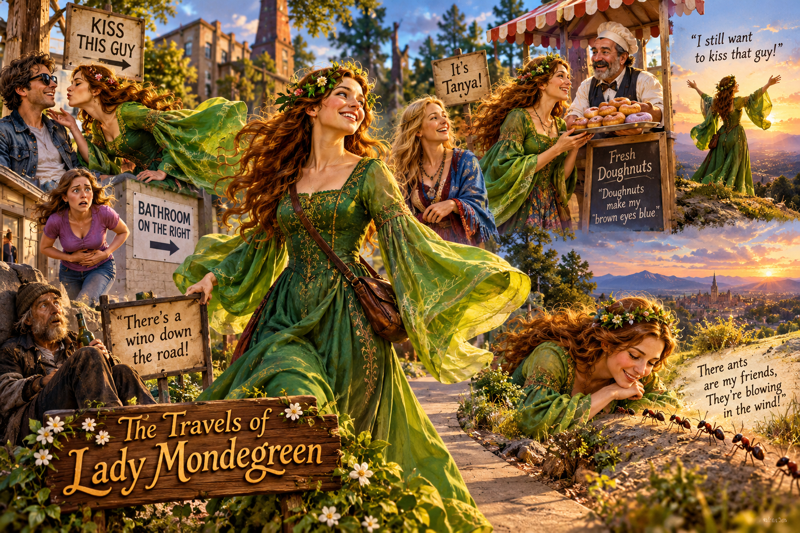
The Travels of Lady Mondegreen

From the work FAWM 2025
Quick Quote
Composer: Roger D. Linder
I shall sing of that fair one The Lady Mondegreen Her sleeves, flapping in the wind, Give off a verdant sheen "Excuse me, please," she once did say "I'd like to kiss this guy. Just once and then I'm sure I'll be Able to touch the sky." The lady fair, her eyes aglow Spots Judy in a fright The girl with colitis goes by "There’s a bathroom on the right." "Such joy to the visions that the people see" She remarked as along she strode But then a sight where she could not agree "There's a wino down the road!" Accompanied by another fair one "It's Tanya! I declare!" Innocent Tanya, bound to leave her Drowning in despair "My lady fair," a pastry vendor Sought her attention, too. "Would you please sample my fare?" "Doughnuts make my brown eyes blue" A breezy day, she sees a hill Despair afflicts, and much chagrined “The ants are my friends, They’re blowing in the wind!” And now upon dear Mondegreen I saw delight in her eye For she once again found her man "I still want to kiss that guy"
Commentary

Other Comments

@metalfoot - 2025-02-17 LOL LOL LOL So many mondegreens, so little time! Well done.

AI Song Analysis

AI review by Claude

1. Blind Interpretation

Narrative and Character Relationships

On a literal level, the text presents a whimsical, episodic ballad detailing the journeys of a central figure named "Lady Mondegreen". The narrative is structured as a series of strange encounters with eccentric characters and surreal sights. The speaker acts as a detached bard or observer ("I shall sing of that fair one") tracking her movements. Lady Mondegreen herself possesses a mercurial personality—shifting rapidly between romantic longing ("I'd like to kiss this guy"), sudden anxiety or judgment ("There's a wino down the road!"), deep existential despair, and ultimate contentment. Her relationships are fleeting and fraught with misunderstanding or impending tragedy, notably her association with "innocent Tanya," who is destined to leave her "drowning in despair."

Imagery, Symbolism, and Internal Logic

The imagery operates under a dreamlike, surreal internal logic:
  • The Verdant Sheen: Her sleeves give off a green glow, establishing her as an almost supernatural, folkloric figure tied to nature or illusion.
  • Physical vs. Metaphysical Space: The text juxtaposes mundane, gritty elements ("colitis," "bathroom on the right," "wino," "doughnuts") with grand, ethereal desires ("touch the sky," "visions that the people see").
  • The Natural World: Nature is presented as bizarrely sentient or anthropomorphized. Ants are declared to be "friends" who are actively "blowing in the wind," acting as an absurd comfort to her deep chagrin.

Themes and Psychological Implications

At its core, the blind text explores the fragmentation of human perception and communication. Lady Mondegreen seems to live entirely in her own head, reacting to the world around her with a series of non-sequiturs. She craves profound connection—symbolized by her recurring desire to "kiss this guy" and touch the heavens—yet her interactions with pastry vendors, winos, and suffering girls are jarringly disjointed. There is a distinct psychological undercurrent of coping with isolation through beautiful, albeit nonsensical, fabrications.

2. Context-Aware Interpretation

The Linguistic and Cultural Context

When external context is introduced, the entire meaning of the text shifts radically. The piece is explicitly an exercise in linguistic humor based on the concept of the mondegreen—a term coined by Sylvia Wright for a misunderstood or misinterpreted word or phrase resulting from a mishearing of the lyrics of a song. Every single stanza, outside of the narrator's framing devices, relies directly on famous, real-world musical misheard lyrics:
  • "Lady Mondegreen" itself comes from the classic mishearing of the Scottish ballad The Bonny Earl of Murray ("and laid him on the green").
  • "Excuse me, please... I'd like to kiss this guy" is the iconic mishearing of Jimi Hendrix’s Purple Haze ("'Scuse me while I kiss the sky").
  • "The girl with colitis goes by / There’s a bathroom on the right" parodies The Beatles' Lucy in the Sky with Diamonds ("The girl with kaleidoscope eyes") and Creedence Clearwater Revival's Bad Moon Rising ("There's a bad moon on the rise").
  • "There's a wino down the road!" references Elton John's Goodbye Yellow Brick Road ("Where the dogs of society howl").
  • "It's Tanya! I declare!" references John Denver’s Thank God I’m a Country Boy ("City girls just fine, but they look like Tanya Tucker," misheard from "look like a lemon to a cookie").
  • "Doughnuts make my brown eyes blue" is a play on Crystal Gayle's Don't It Make My Brown Eyes Blue.
  • "The ants are my friends, they’re blowing in the wind!" is the legendary mishearing of Bob Dylan’s Blowin' in the Wind ("The answer, my friend, is blowin' in the wind").

Songwriter Intent and Production Context

Composed by Roger D. Linder for FAWM 2025 (February Album Writing Month), the song is intentionally designed as a meta-textual novelty track. Linder's intent is not to construct a sincere tragedy about a heartbroken woman named Mondegreen, but rather to weave a tapestry of shared cultural slip-ups into a cohesive, tongue-in-cheek narrative thread. The character of Lady Mondegreen is a literal personification of auditory illusion.

3. Comparative Analysis

Stability vs. Shift

What Shifted: The entire foundational reality of the lyrics transformed. In Phase 1, phrases like "the girl with colitis" or "doughnuts make my brown eyes blue" read as avant-garde, absurdist theater or psychological manifestations of a broken mind. In Phase 2, they lose their literal, dark, or surreal weight and become clever punchlines rooted in pop-culture history. What Remained Stable: Surprisingly, the emotional arc of the character holds together structurally. Even knowing these are misheard lyrics, Linder successfully binds them through a narrator who treats Lady Mondegreen with genuine folkloric reverence, maintaining the "independent literary success" of a whimsical journey.

Intrinsic Meaning vs. Authorial Meaning

This song perfectly highlights the tension between intrinsic and authorial meaning. Intrinsically, the text reads like a Lewis Carroll or Edward Lear nonsense poem, relying on linguistic dissonance to evoke a dreamstate. Authorially, it is a brilliant puzzle-box of musical trivia. Without the context, a reader completely misses the joke, yet they still experience a distinct, surreal artistic flavor. Context dramatically diminishes the accidental avant-garde darkness of the piece but exponentially enhances its intellectual wit and comedic value.

4. Classification

The relationship between the blind and context-aware interpretations is Transformational and Symbolically Elastic.

Why Transformational?

It is transformational because the introduction of external historical data completely alters the genre of the piece—shifting it from an absurdist, melancholic folk tale about human disconnection into a lighthearted, meta-fictional tribute to pop-music history.

Why Symbolically Elastic?

The text displays massive symbolic elasticity. A line like "The ants are my friends" stretches seamlessly from an image of deep psychological coping mechanism (finding comfort in insects) to a literal phonetical stand-in for the word "answer."

5. Final LAM Assessment

The application of the Linder Analysis Method reveals The Travels of Lady Mondegreen to be a masterclass in structural dualism. On its surface (Phase 1), the text behaves like traditional poetry utilizing subconscious surrealism, where the reader does the heavy lifting to bridge the logical gaps between winos, colitis, and floating ants. Beneath the surface (Phase 2), it reveals itself to be a meticulously engineered comedic narrative where every structural anomaly is vindicated by a real-world cultural reference. Ultimately, the song achieves a rare feat in the LAM framework: it functions as an entertaining, eccentric character study to the uninitiated listener, while delivering a completely separate, highly satisfying layer of inside-wit to those who know the history of the airwaves.